
How to Search Prentiss County Court Records
The search starts with one question: which court holds the file? Prentiss County does not run a single case portal. Each court keeps its own records, and the office that owns a case is the office to ask first. Circuit Court handles felonies, larger civil suits, and appeals from lower courts. Chancery Court handles divorce, estates, land, and family equity. Justice Court handles traffic tickets and county misdemeanors. Once the court type is clear, the right clerk and the right online tool fall into place.
A few details speed up any request. Have a name, a case or cause number, and a rough filing date ready. A driver who needs a traffic file should keep the citation number close too. With those in hand, the steps that follow work for most searches.
- Name the record type first. Decide if it is a Circuit Court felony or civil file, a Chancery divorce, probate, or land matter, a Justice Court traffic or misdemeanor case, a restricted Youth Court matter, or a Sheriff jail or warrant record.
- For Circuit or County Court cases, contact the Circuit Clerk and ask whether the file is on MEC, open at a public terminal, available by copy request, or open only by in-person review.
- For Chancery cases, contact the Chancery Clerk. For land records, start with the Chancery Records Online portal, but treat the courthouse index as the official one.
- For traffic and low-level matters, reach the Justice Court Clerk. Fines are paid through MyFinePayment.com or by phone.
- For a court date, call the clerk rather than trust a stale calendar, since published settings can change without notice.
- For a certified copy, ask the clerk for the copy cost, the certification charge, accepted payment, and any photo-ID rule.
- For sealed, expunged, juvenile, or adoption files, expect limits and ask about court-order or party-only access.
Which Clerk Holds Each Prentiss County Record
Mississippi's trial courts split the work, and that split decides where a record lives. The state judiciary publishes the full court structure, from the Supreme Court down to Justice and Youth courts. The Mississippi Judiciary overview of the courts shows how each level connects.
That structure matches the local offices in Booneville, where the same case types route to the same clerks every time. Picking the wrong office is the most common reason a search stalls. The list below pairs each record group with the office that keeps it.
- Circuit Clerk: civil and criminal Circuit and County Court files, judgments, executions, marriage licenses, and juror records.
- Chancery Clerk: divorce, custody, estates, guardianships, conservatorships, land records, deed indexes, and board minutes.
- Justice Court Clerk: traffic citations, county misdemeanors, preliminary criminal matters, and small civil claims.
- First Circuit and First Chancery MEC: electronic case files for matters filed since the 2022 go-live dates.
- Chancery Records Online: the land-record index, board minutes, and a property-fraud alert tool.
- Sheriff and the state prison system: arrest, booking, jail, and custody records held by law enforcement, not the clerks.
Chancery Records Online and MEC Access
Most cases filed in recent years sit in Mississippi Electronic Courts, the statewide e-filing system known as MEC. The Mississippi Electronic Courts overview explains how the system runs and who may register for access.
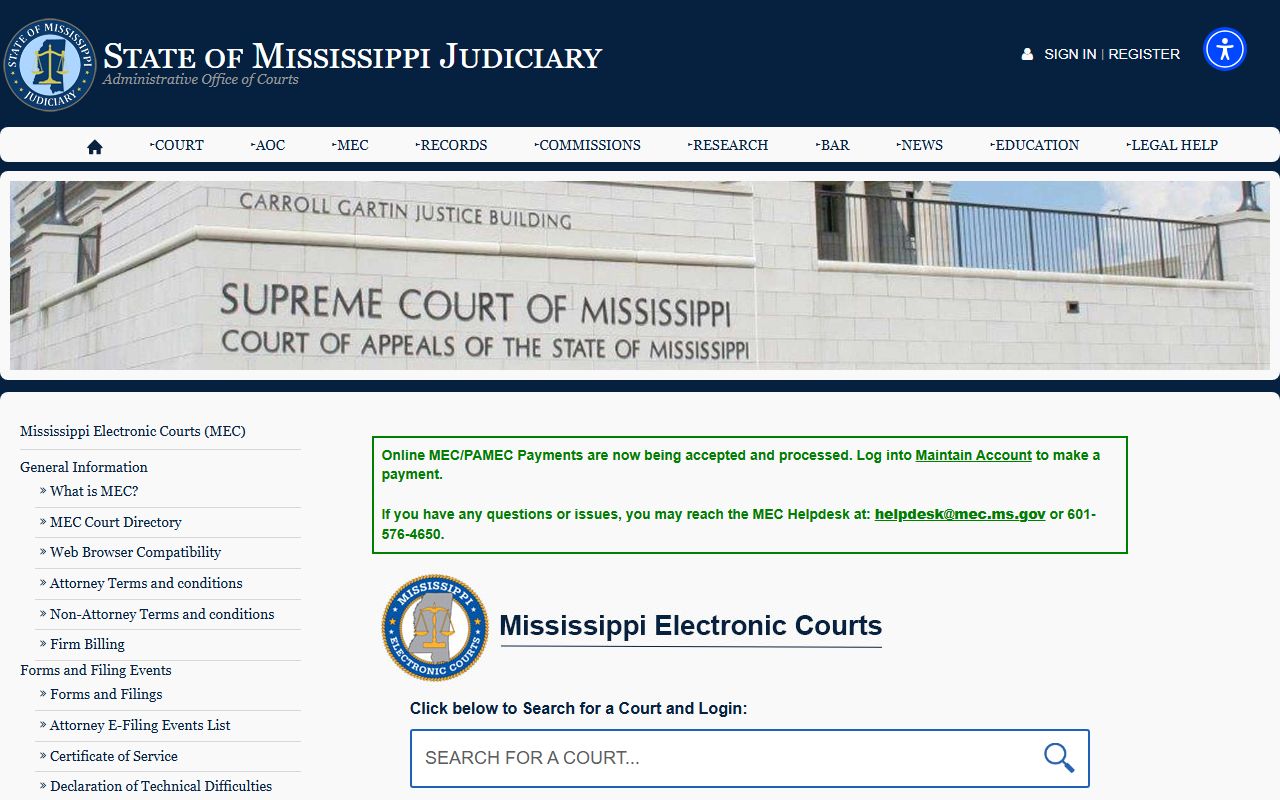
Prentiss County joined MEC through its two districts in 2022. The First Circuit MEC court information page and the First Chancery MEC court information page list the local settings for each district. Public users reach filings through Public Access to MEC, or PAMEC, which runs a help desk for log-in and fee questions.
| Setting | First Circuit | First Chancery |
|---|---|---|
| Software | MEC (CM/ECF V4.0) | MEC (CM/ECF V4.0) |
| Maximum PDF file size | 300 MB | 600 MB |
| MEC live date | 08/22/2022 | 07/25/2022 |
| Office hours | 8 a.m. to 5 p.m. | 8 a.m. to 5 p.m. |
| Public access (PAMEC) phone | 601-576-4650 | 601-576-4650 |
Land and property research has its own tool. The Prentiss County Chancery Records Online portal opens the deed index, board minutes, and a property-fraud alert. The Chancery Clerk offers it as a convenience for any user with an internet connection. The portal controls are simple, and each button opens a separate application.
| Field / Control | Type | Required | Notes / Format |
|---|---|---|---|
| Official Land Records | Button | Optional | Opens the land-record index. The online index is not official; the courthouse Land Records Index controls. |
| Board Minutes | Button | Optional | Opens the board-minutes application. |
| Property Fraud Alert | Button | Optional | Opens the deed-notification and property-fraud alert tool. |
Important: Copies bought online by credit card are final, and the service fee runs 3.5 percent with a two-dollar minimum. The online index is a convenience copy; the courthouse index is the legal one.
Types of Prentiss County Court Records
Court records here fall into a handful of broad groups. The group depends on the court that opened the case and the kind of dispute behind it. Circuit Court produces the heaviest criminal and civil files. Chancery Court produces family and property files. Justice Court produces the high-volume traffic and misdemeanor docket.
Each group carries its own paperwork. A felony file holds an indictment and a sentence; a divorce file holds a complaint and a decree; a land file holds a deed and an index entry. The full criminal case file, with charges, pleas, and disposition, is detailed on the Prentiss County criminal court records page.
- Civil Circuit Court files: complaints, answers, motions, judgments, and executions.
- Criminal Circuit Court files: indictments, bond orders, pleas, verdicts, and sentencing orders.
- Chancery and family files: divorce, custody, support, property division, and adoption pleadings.
- Probate files: wills, letters of administration, inventories, accountings, and final decrees.
- Justice Court files: traffic citations, fines, county misdemeanors, and small civil claims.
- Youth Court files: delinquency and child-welfare matters that stay confidential.
What Prentiss County Court Records Show
A case file is built from a set of standard fields. Most files name the parties, log the events in date order, and track the money owed. Reading a record is easier once those fields are clear. The table below maps the common fields to what each one tells you.
| Field | What It Shows |
|---|---|
| Case Number | The filing year, a sequential number, a judge suffix, and the county letters "PR" assigned to Prentiss under the First Circuit local rule. |
| Parties | Plaintiff and defendant, or petitioner and respondent in Chancery, plus the attorneys for each side. |
| Filing Metadata | Filing date, court, county, assigned judge, case status flag, and the clerk office of record. |
| Docket Events | Motions, orders, hearings, trial settings, continuances, indictment, plea, and similar entries in time order. |
| Financial Fields | Filing fees, court costs, fines, bond, copy charges, and any supervision fee in a diversion program. |
| Case Flags | Status codes such as Trial Pending, Nolle Pros Pending, Bench Warrant Issued, EXPUNGED, or SEALED. |
| Restrictions | Sealed, expunged, juvenile, adoption, and minor-child material that may be hidden or redacted. |
The docket is the heart of the file. It lists every step, from the first filing to the final order, and it is the part most people want when they look up a case. The schedule of upcoming settings is covered on the Prentiss County court dockets page. Older case numbers may use suffixes that have since changed, so confirm any code against a live docket.
Public Access Laws for Prentiss County Court Records
Mississippi law treats most court and county files as open to any person. The Mississippi Public Records Act guide from the Ethics Commission sets out that right under Miss. Code Ann. Section 25-61-1 and the sections that follow it.
The Act also sets the rules for timing and cost. Under Section 25-61-5, a public body must grant access or explain a delay or denial, and it should release the open parts of a file even when some parts must be held back. Under Section 25-61-7, an office may charge the actual cost of searching, reviewing, redacting, copying, and mailing a record, and it may ask for prepayment.
The practical rule in Prentiss County is plain: ask the office that holds the file. The Circuit Clerk covers Circuit and County Court files and judgments. The Chancery Clerk covers divorce, probate, land records, and older county papers. Justice Court covers traffic and minor matters, and the Sheriff covers arrest, booking, and jail records.
Note: Not every court file is open; an office may redact exempt material such as Social Security numbers, medical data, or victim details before it releases the rest.
Sealed and Expunged Prentiss County Records
Some files stay closed by law. Youth Court records on delinquent, neglected, or abused children are confidential and reach only the parties, their lawyers, agencies, or persons a court allows. Sealed cases carry a SEALED flag and stay out of public view unless a judge unseals them. Records marked EXPUNGED should not turn up in an ordinary search at all. Adoption filings and mental-health commitments are likewise sensitive and limited.
Expunction starts in the court where the charge or conviction happened. A felony or appellate criminal file routes back to the Circuit Clerk, while a misdemeanor or traffic matter routes to the Justice Court Clerk. Miss. Code Ann. Section 99-19-71 controls much of the eligibility, including waiting periods and the offenses that can never be cleared.
The path is consistent even when the outcome is not. A person files a petition in the court of conviction, the prosecutor may respond, and the judge decides whether the statute is met. If the court grants relief, the clerk and related agencies process an order that removes or restricts public access. No office can promise eligibility in advance, so ask the court of conviction for its current petition process.
Requesting Prentiss County Court Records in Person
When an online system comes up short, the courthouse counter still works. Both main clerk offices sit on North Main Street in Booneville and keep weekday business hours. Bring a photo ID, the names or case number, and a way to pay any copy or certification fee. Older or offline files almost always need a visit or a call rather than a click.
The two offices below handle the bulk of public court-record requests in the county. Match the request to the right clerk to avoid a second trip.
Prentiss County Circuit Clerk
Michael R. Kelley
101A North Main Street, PO Box 727
Booneville, MS 38829
662-728-4611
Mon to Fri, 8am to 5pm
Prentiss County Chancery Clerk
David "Bubba" Pounds
100 North Main Street, PO Box 477
Booneville, MS 38829
662-728-8151
Mon to Fri, 8am to 5pm
The Circuit Clerk files lawsuits and indictments, keeps judgments, issues marriage licenses, and draws jurors. The Chancery Clerk serves as public recorder, board clerk, and county treasurer, and holds the deed and estate files. Between the two counters and the state systems above, nearly every Prentiss County court record is within reach.