
What Probate Covers in Prentiss County
In Mississippi, probate is a Chancery Court function. There is no stand-alone probate court in Prentiss County. The Chancery Court is the equity court, and it hears the estates of people who have died, along with the family and property matters tied to them. The county courts page lists estates of decedents, guardianships, conservatorships, insurance settlements paid to minors, mental-health commitments, and title disputes among the cases this court decides. Probate is the legal name for the process that proves a will, settles debts, and passes property to heirs.
The work is split between the bench and the counter. Chancellors decide the cases, and the Chancery Clerk receives and stores the files. Prentiss County sits in the First Chancery Court District, where the chancellors are Jacqueline Mask, Michael Malski, Stephen T. Bailey, and Bradley D. Tennison. As Clerk of the Chancery Court, the Chancery Clerk handles estates, guardianships, conservatorships, heirship cases, minor claims, and other equity filings. That makes the clerk the first stop for a probate record search.
Probate reaches well past a simple will. It covers people who die without a will, minors who receive money, and adults who can no longer manage their own affairs. Each of those situations opens a different kind of Chancery case.
Probate Terms Defined
Probate paperwork uses words that rarely come up in daily life. A short glossary makes a Prentiss County estate file easier to read. The terms below appear across wills, petitions, and the orders a chancellor signs.
- Testator
- The person who made the will. The will speaks for the testator after death.
- Executor
- The person named in a will to carry out its terms, pay debts, and distribute property.
- Administrator
- The person the court appoints to settle an estate when there is no will or no named executor.
- Intestate
- Dying without a valid will. State law then sets who inherits and in what share.
- Guardianship
- Court-supervised authority over a minor or an incapacitated person and that person's care.
- Conservatorship
- Court-supervised management of another person's property and financial affairs.
How to Search Prentiss County Probate Records
Probate records can be reached through more than one channel, and the best one depends on the age of the file. The Chancery Clerk counter is the strongest route for older estate, will, guardianship, and conservatorship files, and for certified copies. Newer cases may also appear in the state electronic court system. Prentiss County Chancery Court went live on the Mississippi Electronic Courts system on July 25, 2022, so files opened before that date may not be fully electronic. Land records tied to an estate, such as deeds and liens, sit in a separate online portal.
- Decide what you need, such as an estate file, a will offered for probate, a guardianship, or a certified copy of an order.
- Call the Chancery Clerk at 662-728-8151 to confirm whether the file is at the counter, in storage, or in the electronic system.
- Check the First Chancery MEC court information page for electronic case access, and review the statewide Mississippi Electronic Courts overview for registration details.
- For estate-related land transfers, search the Chancery Records Online portal, keeping in mind the online index is not the official record and the courthouse index controls.
- If a record is not online, file a Mississippi Public Records Act request with the Chancery Clerk for the non-confidential parts of the file.
Note: The online land-records index is a finding aid only, so confirm any estate transfer against the certified courthouse index before relying on it.
Prentiss County Chancery Clerk and Court Contacts
Probate files in Prentiss County are kept by the Chancery Clerk, who serves as Clerk of the Chancery Court. David "Bubba" Pounds runs the office in downtown Booneville. The First Chancery District Court and the county Government Annex share the same phone line and mailing box, so a quick call confirms which door to use before you drive in. Office duties and contact details appear on the county Chancery Clerk page.
Prentiss County Chancery Clerk
David "Bubba" Pounds
100 North Main Street, PO Box 477
Booneville, MS 38829
662-728-8151
Estates, guardianship, conservatorship, and probate files
1st Chancery District Court / Government Annex
200 Bridge Street, PO Box 477
Booneville, MS 38829
662-728-8151
Chancery Court hearings and annex office services
The clerk is also the public recorder for the county, so deeds and liens that touch an estate run through the same office. Divorce, custody, and other family files share this court too, and those are covered on the Prentiss County marriage and divorce records page. The office profile and recording duties are detailed on the Chancery Clerk page.
Prentiss County Probate Filing Fees
The Chancery Court publishes a flat total filing fee for most case types. Estates, guardianships, conservatorships, and the related probate filings each carry the same charge. The amounts below come from the Prentiss County Chancery Court fee schedule. Copy and certified-copy costs are billed separately, so ask the clerk for the current page rate when you order documents.
| Filing type | Total fee |
|---|---|
| Estates (all) | $149.00 |
| Guardianship | $149.00 |
| Conservatorship | $149.00 |
| Heirship determination | $149.00 |
| Adjudication of heirs | $149.00 |
| Minor's claim | $149.00 |
| Structured settlement | $149.00 |
| Removal of minority | $149.00 |
| Adoption | $149.00 |
| Answer | $10.00 |
| Counter complaint or cross complaint | $0.00 |
Note: The flat $149 fee covers the filing itself, while bonds, guardian ad litem charges, publication costs, and copy fees are added based on what the case needs.
How Probate Works in Prentiss County
A Prentiss County estate moves through a set of stages, and the file grows at each one. The path differs for a will versus an estate with no will, but the broad shape holds. The steps below trace how a typical estate opens, runs, and closes in the Chancery Court.
- An interested party files the opening papers in Chancery Court through the Chancery Clerk. If there is a will, it may be offered for probate; if not, an administration or heirship matter is filed.
- The court may appoint an executor, an administrator, or a guardian or conservator to act for the estate or the protected person.
- Bonds, an inventory, and accountings may be required, though a chancellor can waive any of these by order.
- Notice goes to heirs and creditors, sometimes by publication, depending on the case type and the court's direction.
- A final accounting, discharge, distribution, and a closing decree or order end the matter.
Minor and guardianship matters add their own steps. A guardian ad litem may be appointed to protect a child's interest, and money paid to a minor may be held in a court-supervised account. These safeguards are why minor settlement and guardianship files draw extra court review.
What Prentiss County Probate Records Show
A probate file gathers the full life of an estate or guardianship in one place. No public sample estate file was reachable without a case login, so the field list below is inferred from the official Chancery fee schedule and the Mississippi Electronic Courts flag inventory rather than from a sampled record. It still gives a fair picture of what a Prentiss County probate record is likely to hold.
| Field | What it shows |
|---|---|
| Case number and filing date | The court's case identifier and when the matter opened. |
| Court and chancellor | The Chancery Court and the assigned chancellor. |
| Parties | Petitioner, plus the decedent, minor, or protected person. |
| Attorney | Counsel of record for the estate or petition. |
| Case type | Estate, guardianship, conservatorship, heirship, or minor claim. |
| Inventory and accounting status | Whether duties are pending or marked waived by order. |
| GAL and trust flags | Guardian ad litem appointment or a court-held trust account. |
| Orders and notices | Bonds, notices, decrees, and any sealed or restricted markers. |
The electronic system also carries short status flags such as inventory waived, accounting waived, bond waived, and minor child. These tags signal what the court has required or excused, and they help a reader follow the state of a case at a glance.
Federal Estate and Bankruptcy Matters
Almost every probate question in Prentiss County stays in the state Chancery Court. A narrow band of matters does not. Federal estate-tax disputes, a bankruptcy that pulls in a decedent's estate, and other federal claims route to the United States District Court for the Northern District of Mississippi instead of the county courthouse. That federal channel runs on its own electronic systems, and access works differently from the Chancery Clerk counter.
The federal court explains how its public access works on its case information page. It describes PACER as the service that delivers docket and case data from federal courts.
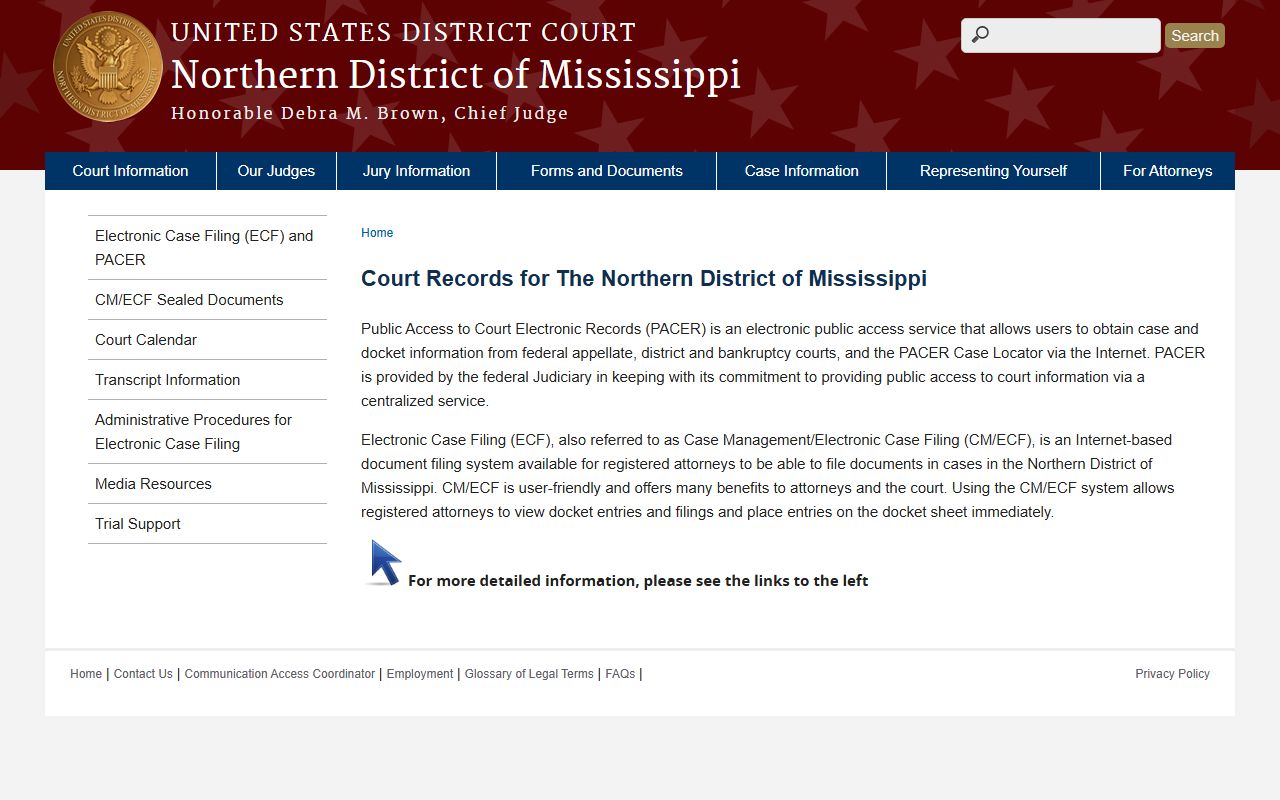
The page above sets the boundary between county probate and federal litigation. It is the right starting point only when an estate question has truly become a federal matter.
Documents in a federal case are filed and viewed through the court's electronic docketing system. That system is reached at the Northern District CM/ECF portal, which attorneys use to file and the public uses to read dockets.
The login screen shown here is for the federal docket, not for a county estate file. A Prentiss County will or guardianship never appears in this system.
Registration for federal access is handled through PACER, which charges fees and requires an account. The court directory entry sits on the PACER lookup page for the Northern District.
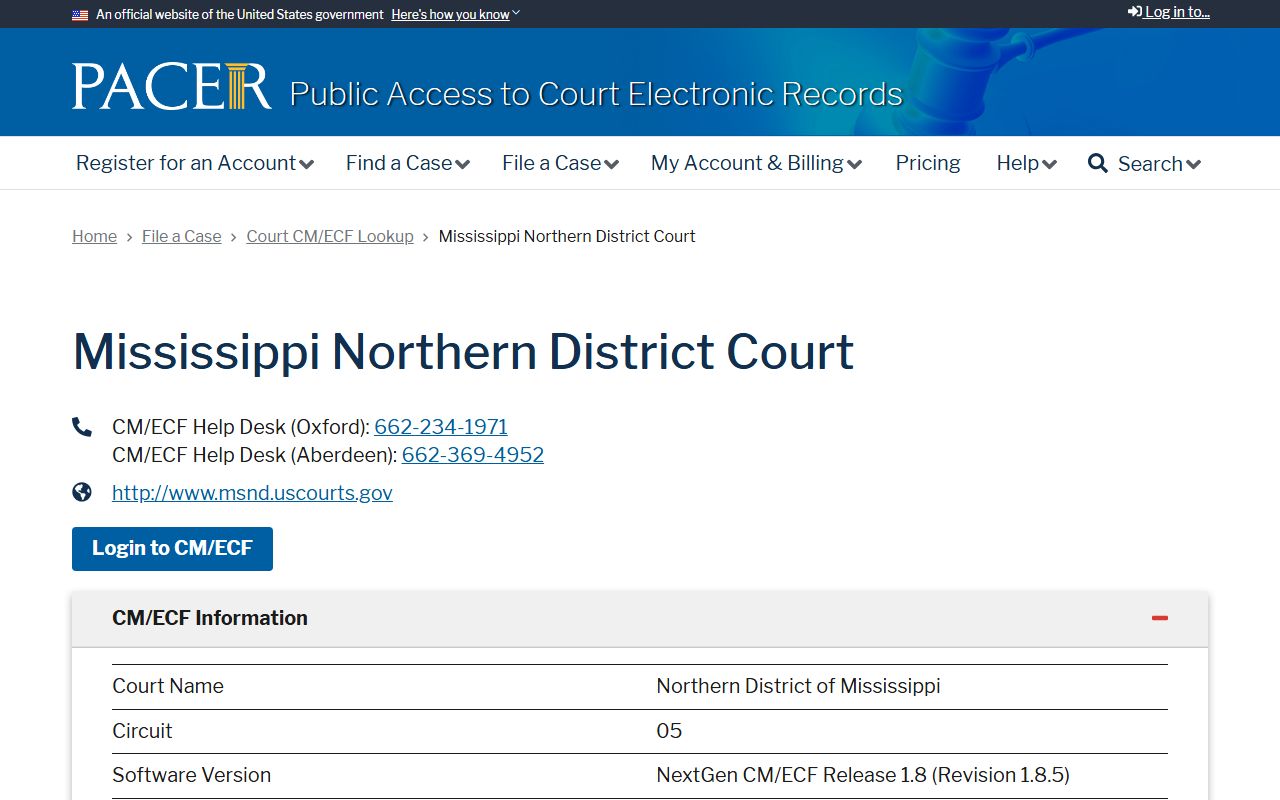
The PACER listing above confirms the court's identifiers for federal filers and searchers. Bankruptcy matters that touch an estate run through the separate Northern District Bankruptcy Court on the same PACER framework.
Restricted Prentiss County Probate Records
Not every Chancery file is open to the public. Probate sits next to several case types that the law shields, and some details inside an otherwise open estate may be sealed or redacted. Access to a protected file usually depends on party status, attorney standing, or a court order. The categories below are the ones most likely to be closed or limited.
- Adoption files, which the Chancery Court treats as confidential.
- Guardianship and conservatorship records that involve a minor or a protected adult.
- Minor settlement and minor-claim material, including evaluations and protected information.
- Mental-health and commitment matters heard by the Chancery Court.
- Files or parts of files marked sealed by a chancellor's order.
Personal identifiers add another layer. Social Security numbers, financial account numbers, and medical details are commonly redacted before a file is released. The Mississippi Public Records Act backs access to the open parts of a record while allowing a public body to withhold exempt material. The statute and its fee and timing rules are posted on the Mississippi Ethics Commission public records page.
When a record is closed, the path forward is to ask the court rather than an outside site. The Chancery Clerk can explain what proof of standing or what court order is needed before a restricted guardianship, conservatorship, adoption, or commitment file can be opened.