
Criminal Court Records in Prentiss County
A criminal court record is the case file a clerk opens once charges are filed against a named defendant. In Prentiss County, the Circuit Clerk receives and files indictments, motions, and papers in felony cases, then keeps the judgments and orders that follow. The file is the official account of the prosecution. It is not a police blotter, and it is not the same as a jail booking sheet. The record tracks one matter, the State of Mississippi against a defendant, from the first charge to the final ruling. Each entry is dated and tied to a case number.
Two court levels handle criminal matters here. Felony prosecutions are heard in Circuit Court, part of the First Circuit Court District. Justice Court handles traffic, county misdemeanors, and the early stages of some criminal cases before they move higher. Many felonies start with an arrest and a Justice Court appearance, then proceed to a grand jury and an indictment. After indictment, the Circuit Court file becomes the core record, holding the charges, docket events, pleas, disposition, sentence, and bond. The arrest side and the charges themselves are covered in the arrest records and court charges pages.
The First Circuit District spreads its courthouses across northeast Mississippi. The district publishes its courthouse locations for the seven counties it serves. Prentiss County criminal files are kept at the Circuit Clerk office in Booneville, the place to call when a case does not appear in an online system.
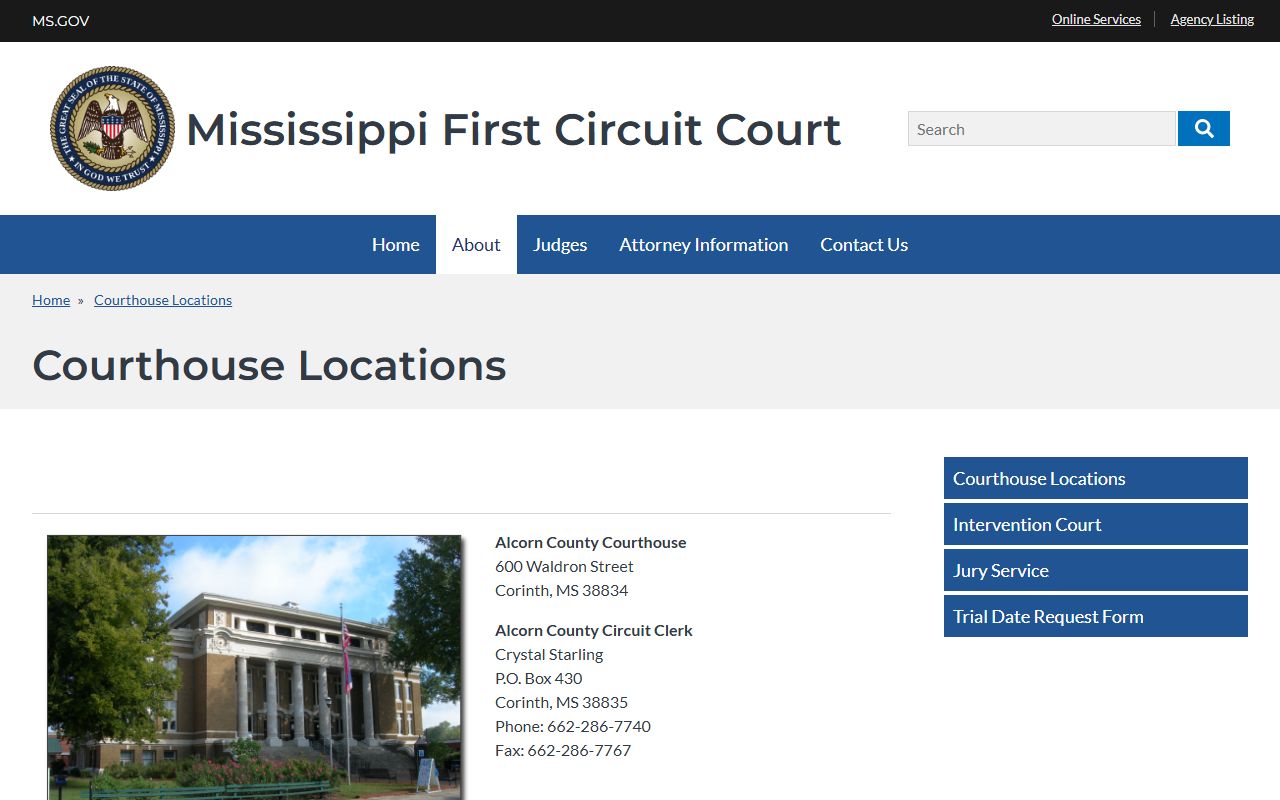
Knowing the right courthouse saves time. A felony file in Booneville will not surface at a sister county clerk, and an out-of-county matter will not appear in the Prentiss County index.
How to Search Prentiss County Criminal Court Records
Prentiss County does not publish one all-purpose public case-search website. Felony case files run through the First Circuit MEC system and the Circuit Clerk office. Mississippi Electronic Courts, or MEC, is the statewide electronic filing and case-management platform, and public access flows through PAMEC. Reading a felony case usually means starting with the clerk and asking how the file can be viewed.
- Identify the record as a felony or serious criminal matter handled in Circuit Court, not a Justice Court traffic or misdemeanor case.
- Open the First Circuit MEC court information page to confirm the court, software, and contact details.
- Reach public access through the statewide Mississippi Electronic Courts system, which routes registered users to case and docket information.
- Call or visit the Circuit Clerk to ask whether a case is available through MEC, at a public terminal, by copy request, or only by in-person file review.
- Request a certified copy of the indictment, plea, or sentencing order from the clerk when a court-ready document is needed.
Scheduling across the seven counties is supported by a court administrator, a role the district describes on its First Circuit Court District page. For records that predate the August 2022 MEC go-live or never moved online, the fallback is the same: call the clerk and use a public-records request when a system shows nothing. Statewide criminal-history searches are run by law enforcement and are separate from the court case file.
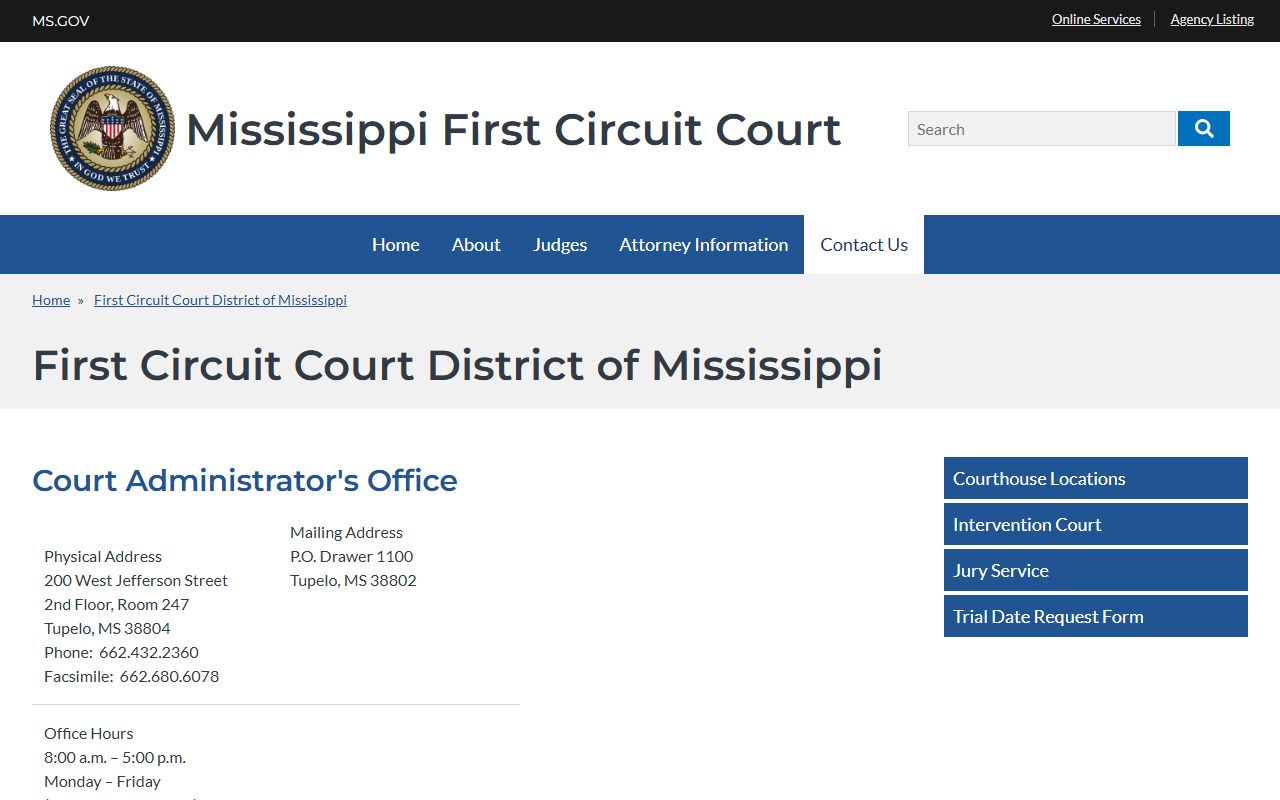
A clerk can confirm copy cost, certification cost, and whether identification is required before a document is released.
Stages of a Prentiss County Criminal Case
A felony case moves through set stages, and each one leaves a mark in the record. The docket reads as a timeline. Filing dates, hearing settings, and orders stack in the order they happened, so the file shows not only where a case ended but how it got there.
Case flow: Charges Filed › Arraignment › Pretrial / Motions › Plea or Trial › Disposition › Sentencing
| Stage | What Happens |
|---|---|
| Charges Filed | A grand jury returns an indictment, or a charge is bound over from a lower court. The Circuit Clerk opens the case file. |
| Arraignment | The defendant is formally advised of the charges and enters a plea. Bond and counsel matters are often addressed here. |
| Pretrial / Motions | Both sides file motions, exchange discovery, and ask the court for rulings. Hearings are set, continued, or canceled. |
| Plea or Trial | The defendant pleads, or the case is tried before a jury. A verdict or accepted plea decides guilt. |
| Disposition | The case outcome is entered, whether a conviction, an acquittal, a dismissal, or a nolle prosequi. |
| Sentencing | After a conviction the judge orders the sentence, which may include prison, probation, or post-release supervision. |
Not every case touches every stage. A charge can be reduced to a misdemeanor, a matter can be deferred, or a plea can close a file before trial. The docket flags show the path each one took.
Note: A case still marked as pending shows an open disposition, so the record will read differently the next time the clerk updates the docket.
What a Prentiss County Criminal Court Record Shows
A felony case file is a collection of dated fields and documents. Some are plain, like a defendant name. Others are coded, like a docket flag that signals a bench warrant or a pending sentence. Together they show who was charged, with what, and how the court resolved it. The fields below appear across First Circuit criminal files.
| Field | What It Shows |
|---|---|
| Case Number | The court identifier, which in Prentiss County carries the county letters PR under First Circuit local numbering. |
| Defendant | The person charged, listed opposite the State of Mississippi as the prosecuting party. |
| Charges | The offenses as filed in the indictment or charging document, with statute references and severity. |
| Plea | The defendant formal response, such as guilty, not guilty, or no contest. |
| Docket Events | Motions, orders, hearing settings, continuances, and flags like Capias Pending or Bound Over. |
| Disposition | The outcome of each charge, including conviction, dismissal, acquittal, or nolle prosequi. |
| Sentence | The punishment ordered after conviction, with prison, probation, fines, or supervision terms. |
Financial fields often sit alongside the case data. A file can list fines, court costs, bond, copy fees, and a supervision fee when an intervention program is involved. Hearing fields add the date, time, judge, courtroom, and trial type. The wider Prentiss County court records overview maps the same data across all case types.
Who Prosecutes Prentiss County Criminal Cases
The State of Mississippi, not a private party, brings a criminal case. Two offices share that work in Prentiss County, and the record often shows which one handled the matter. Understanding the split explains why a charge can move from one court to another before an indictment ever lands.
The District Attorney for the First District, John Weddle, handles felony prosecution for the district and presents serious cases to the grand jury. The County Prosecuting Attorney, Allison A. Worley, represents the state in felony matters before Justice Court, handles criminal appeals from Justice Court to Circuit Court, and covers cases not assigned to the District Attorney. A grand jury reviews the evidence and decides whether to return an indictment, the charging document that opens a felony file in Circuit Court.
Indigent defendants are served through a contract public defender system, with private attorneys paid per contract to handle appointed cases. The record may flag a defendant as Indigent. For appointed counsel, a defendant works through the court handling the case.
Charges vs. Convictions
A charge is an accusation. A conviction is a finding of guilt. The two are easy to confuse in a record, yet they carry very different weight. A criminal court file can show charges that were dropped, dismissed, reduced, or that ended in an acquittal, and none of those is a conviction. Reading the disposition for each count is the only reliable way to tell what actually happened.
| Charge | Conviction | |
|---|---|---|
| Stage | Accusation filed by the state | Verdict or accepted plea of guilt |
| Burden of Proof | Probable cause | Beyond a reasonable doubt |
| Can Change | Reduced, dismissed, or nolle prossed | Stands unless appealed or vacated |
| Public Record | Yes | Yes |
Background screening should respect this line. An open charge is not proof of wrongdoing, and a dismissed count should never be read as a conviction. The disposition field settles the question.
Reading Dispositions and Sentences
The disposition tells how a charge ended. Common entries include guilty, not guilty, dismissed, nolle prosequi, and reduced to a misdemeanor. A no-contest plea accepts punishment without admitting facts. Deferred sentencing holds the sentence open while a defendant meets court conditions. First Circuit MEC files use short flags to mark these states, and learning a few of them makes a docket far easier to read.
The four-judge bench of the First Circuit hears these cases and signs the orders that close them. The district lists its Circuit Court judges and the qualifications they must meet. A sentencing order, signed by the assigned judge, sets the punishment after a conviction.
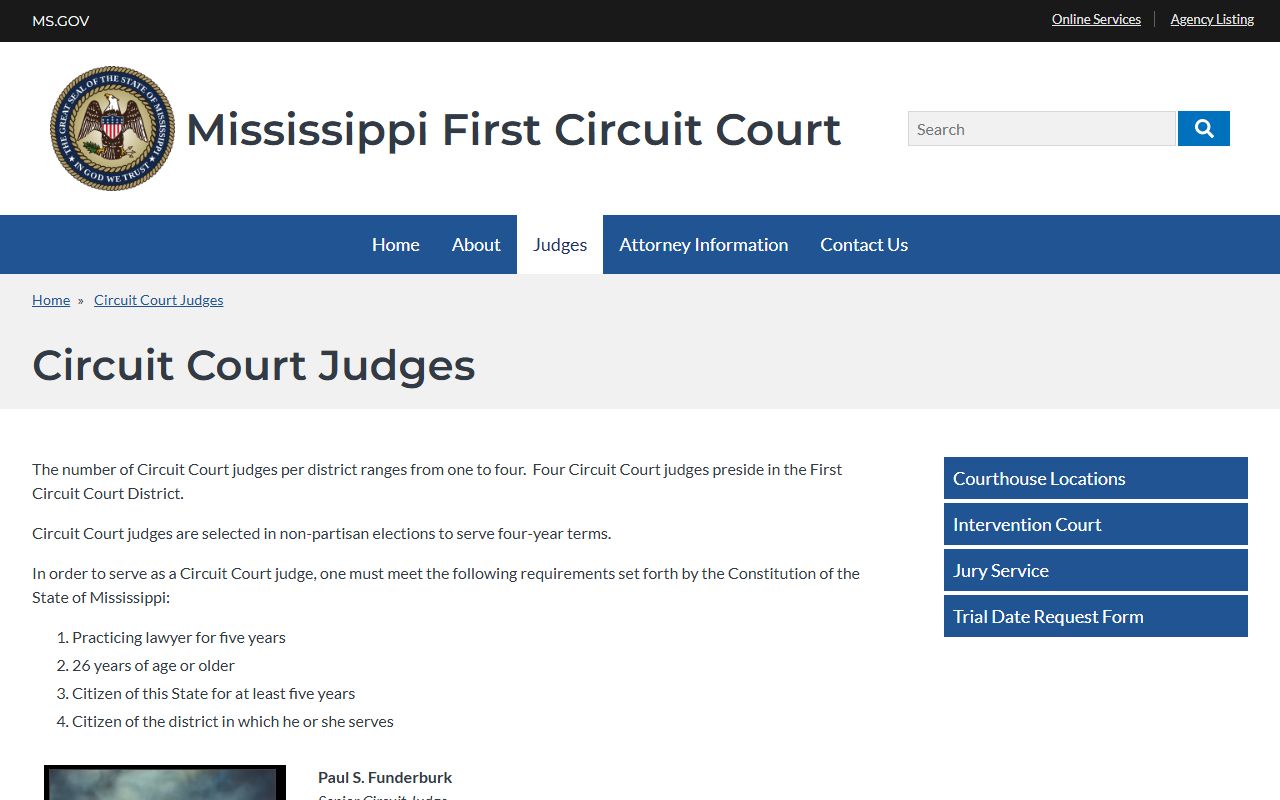
Sentences vary by offense and may show prison time, probation, post-release supervision, fines, or a mix. Docket flags such as Probation Violation Pending, Sentence Pending, or Closed signal where the case stands. A capias or bench warrant flag means the court ordered a person taken into custody, often after a missed appearance.
Adult Felony Intervention Court
Some nonviolent felony defendants with substance-abuse problems are routed into the First Judicial District Adult Felony Intervention Court instead of standard prosecution. It is an intense probationary program that requires treatment, frequent random drug testing, court appearances, home visits, employment, and support-meeting attendance. The program serves all seven counties of the district, including Prentiss County.
Entry follows a plea to the pending felony charge or a probation revocation before a Circuit Court judge, after which the participant begins phase one. The court describes the program on its Adult Felony Intervention Court page. The commitment runs at least 36 months across five phases, and participants pay treatment costs and a monthly supervision fee. The program contact is Jennifer Cummings at 662-728-4060.
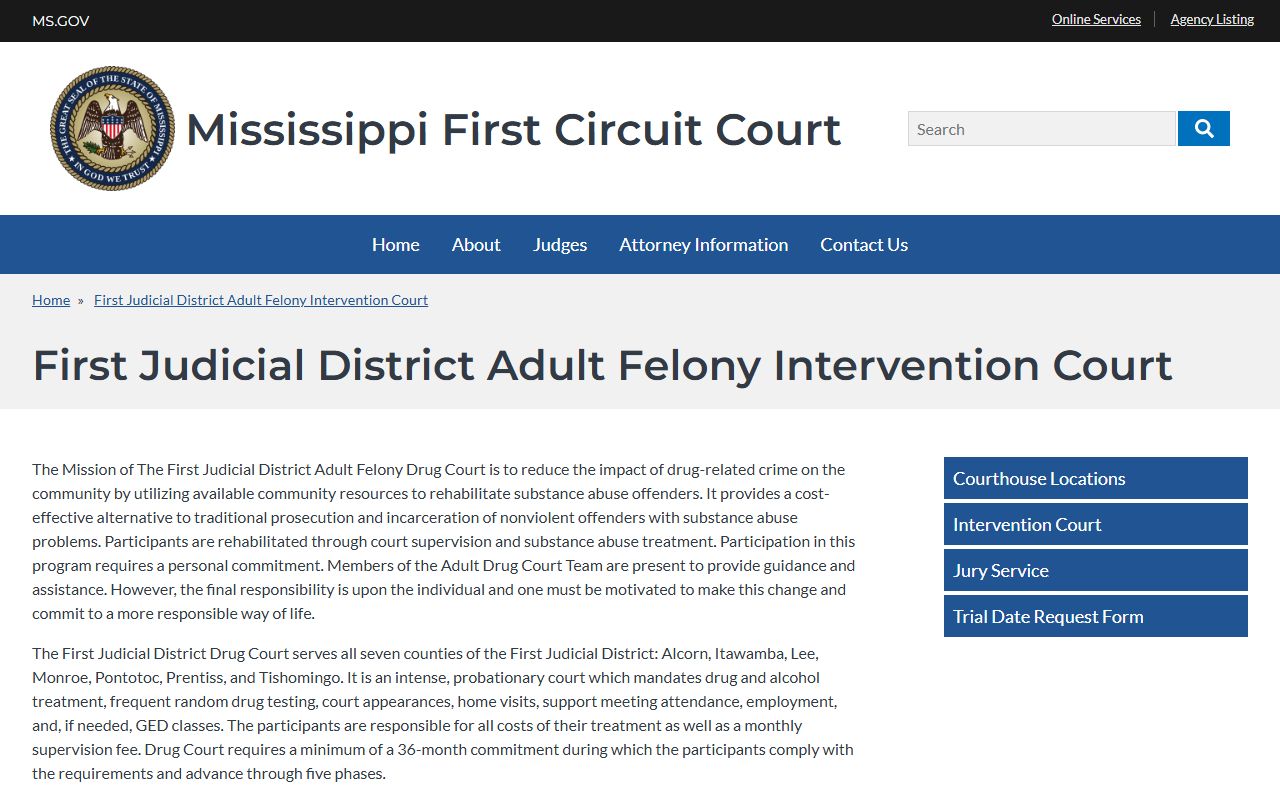
A case in the program may show a Pretrial Intervention Pending flag while the participant works through the phases. The deferred or intervention path can change how the final disposition reads.
Sealed vs. Expunged Records
Sealing and expunction both limit public access, but they are not the same. A sealed case is closed to ordinary public inspection while the file still exists. An expunged record is treated as though the charge never happened, and it should not appear in ordinary public search results. First Circuit MEC files include both SEALED and EXPUNGED flags.
| Sealed | Expunged | |
|---|---|---|
| Visibility | Hidden from public inspection | Removed and treated as never filed |
| File Status | Still exists under court control | Public access restricted by order |
| Law Enforcement | Limited access | Very limited access |
| How It Happens | Court order in the case | Petition under Miss. Code § 99-19-71 |
Expunction starts in the court where the conviction occurred. For a Prentiss County felony, that is the Circuit Court, reached through the Circuit Clerk at 662-728-4611, under Miss. Code Ann. § 99-19-71. A person files a petition in the court of conviction, the prosecutor may respond, and the judge decides whether statutory eligibility is met. Eligibility is narrow and turns on the offense, waiting periods, and sentence completion, so no outcome is guaranteed. Juvenile matters follow a different rule, with youth court confidentiality set under Miss. Code Ann. § 43-21-261. A misdemeanor or traffic-related expunction runs through Justice Court at 662-728-8696 instead.
Public Access to Criminal Court Records
Most Prentiss County criminal case files are open to the public, and Mississippi backs that access by statute. The practical rule is to ask the office that holds the record, which for felony files is the Circuit Clerk. Agencies may charge the actual cost of searching and copying, and they may redact exempt material rather than release a complete file.
Key Statutes:
Miss. Code Ann. § 25-61-1 et seq. - the Mississippi Public Records Act makes public records open for inspection by any person unless a law exempts them.
Miss. Code Ann. § 25-61-7 - a public body may charge reasonable actual costs for searching, reviewing, redacting, copying, and mailing records.
When an online system shows nothing, the records-request path still applies. A written request to the clerk that holds the file is the reliable channel for older or offline criminal records.
Restricted Criminal Court Records in Prentiss County
Not every criminal record is open. Several categories are restricted, sealed, or confidential by law, and the clerk will not release them through an ordinary request. Expect limits in the situations below.
- Youth court and juvenile delinquency files, which are confidential under Miss. Code Ann. § 43-21-261.
- Sealed cases, which stay closed to public inspection unless a judge unseals them.
- Expunged records, which should not appear in ordinary public search results.
- Mental-health and commitment material tied to a case, which is sensitive and commonly restricted.
- Personal identifiers such as Social Security numbers, financial accounts, and protected victim information, which may be redacted.
Access to a restricted file is usually limited to parties, attorneys, agencies, or a person authorized by court order. Anyone seeking such a record should ask the court that holds it about the proper authorization. For a copy of an expungement order already entered, the clerk may require proof of identity first.